
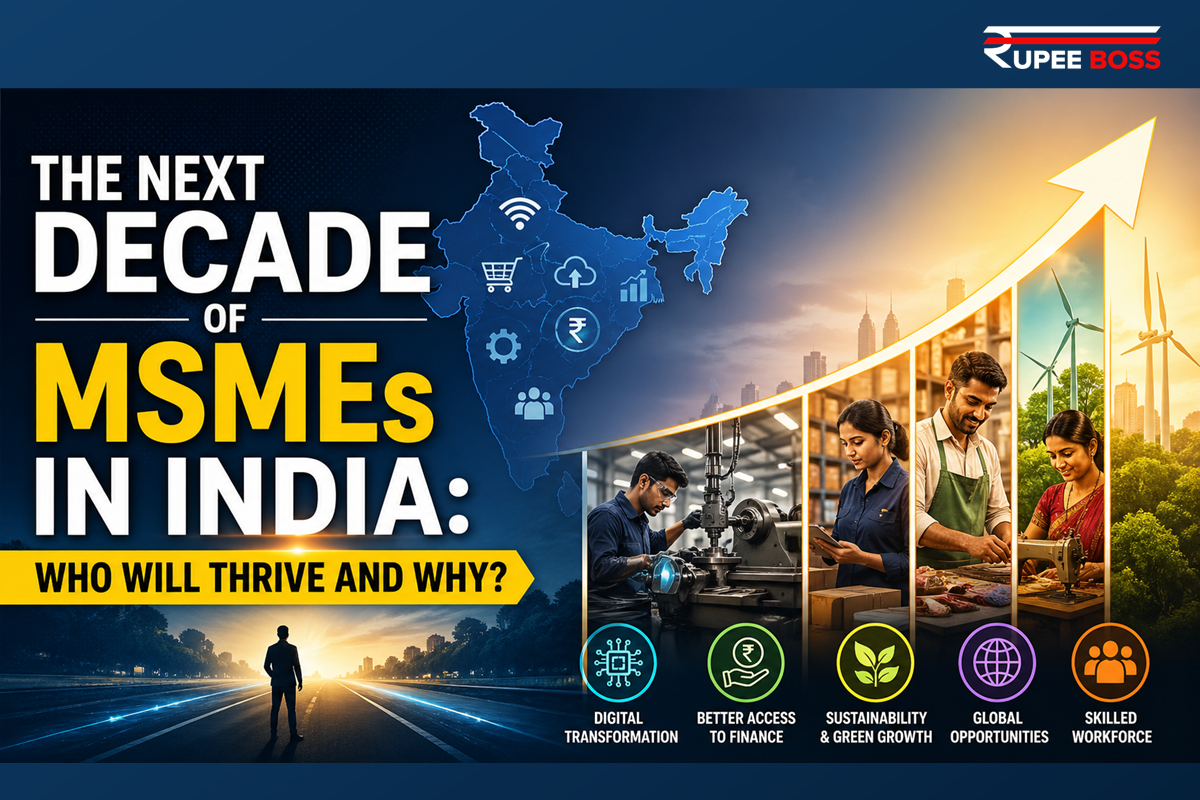
The Silent Engine of India’s Growth
India’s Micro, Small, and Medium Enterprises (MSMEs) sector is often described as the backbone of the economy—and for good reason. It contributes nearly 30% of GDP, employs over 30 crore people, and drives around 45% of exports .
But the next decade (2025–2035) won’t simply be an extension of the past. It will be a period of structural transformation, where some MSMEs will scale globally—while others may struggle to survive.
The question is no longer “Will MSMEs grow?”—but rather:
👉 Which MSMEs will thrive, and what will separate winners from the rest?
1. The Big Shift: From “Small Businesses” to “Scalable Enterprises”
Traditionally, MSMEs were:
Local
Labor-intensive
Informal
But the next decade will redefine them as:
Digital-first
Globally connected
Technology-enabled
By 2030, MSMEs are expected to contribute up to 40% of India’s GDP, signaling massive expansion and formalization .
👉 The transformation is clear:
Scale—not size—will define success.
2. Key Forces Shaping the Future of MSMEs
A. Digital Transformation Will Be Non-Negotiable
Digital adoption has already accelerated, with over 65% of MSMEs using digital tools for operations and sales .
In the next decade:
E-commerce and ONDC will unlock national markets
UPI and digital payments will eliminate friction
Cloud tools will replace manual systems
💡 MSMEs that remain offline or semi-digital will struggle to compete.
B. AI, Automation, and Data Will Redefine Productivity
The future MSME will not rely on cheap labor—but on smart systems:
AI-driven decision-making
Automated manufacturing
Data-led marketing
By 2030, 45% of job skills are expected to change, with a sharp rise in digital and analytical capabilities .
👉 The winning MSMEs will be:
Tech-enabled
Process-driven
Less dependent on founders
C. Formalisation Will Separate the Serious from the Casual
A staggering ~95% of MSMEs still operate informally .
But the next decade will push:
GST compliance
Digital payments
Formal credit systems
💡 Why it matters:
Formal MSMEs will gain:
Easier access to capital
Government benefits
Global market trust
D. Sustainability Will Become a Competitive Advantage
Global markets are increasingly demanding:
Low-carbon manufacturing
ESG compliance
Energy efficiency
India is already pushing MSMEs toward green transformation, with programs targeting energy savings of 20–30% .
👉 Future reality:
“Green MSMEs” will win global contracts.
E. Access to Finance Will Be a Game-Changer
Despite their importance, MSMEs face a massive credit gap and limited access to formal funding .
Over the next decade:
Fintech lending
Digital credit scoring
Supply chain financing
will unlock growth.
💡 MSMEs that build financial discipline and transparency will scale faster.
3. Who Will Thrive in the Next Decade?
Not all MSMEs will benefit equally. Here’s a breakdown:
1. Digital-First MSMEs
Businesses that:
Sell online
Use digital marketing
Leverage platforms like ONDC
👉 These will scale faster and reach global customers.
2. Niche & Specialized Manufacturers
Especially in sectors like:
Defence
Electronics
Pharmaceuticals
Auto components
These MSMEs are already becoming key suppliers to large industries and exports .
3. Export-Oriented MSMEs
With MSMEs contributing nearly half of India’s exports, global demand will drive growth .
Winners will:
Meet global quality standards
Adopt compliance and certifications
4. Tech-Enabled Traditional Businesses
Even legacy sectors like:
Handicrafts
Textiles
Food processing
will thrive—if they:
Go digital
Build brands
Sell globally
5. System-Driven Businesses (Not Founder-Dependent)
A key insight from real MSME founders:
“Revenue can hide inefficiency… real profitability means systems run the business.”
👉 Businesses that:
Build processes
Automate operations
Reduce founder dependency
will outperform others.
4. Who Will Struggle?
❌ 1. Offline & Non-Digital MSMEs
Lack of online presence = limited growth
❌ 2. Informal & Non-Compliant Businesses
No access to credit, partnerships, or exports
❌ 3. Low-Skill, Labor-Only Models
Automation will replace inefficient operations
❌ 4. Founder-Dependent Businesses
Growth stalls without scalable systems
❌ 5. Businesses Ignoring Sustainability
Will lose access to global markets
5. The Role of Government & Ecosystem
India’s MSME growth is heavily supported by:
Udyam Registration
Digital MSME schemes
Make in India
Credit and infrastructure support
These initiatives aim to:
Improve ease of doing business
Enable formalisation
Boost competitiveness
👉 The next decade will see stronger public-private collaboration.
6. The Future Outlook: MSMEs in 2035
By 2035, the MSME sector could look like this:
Highly digitized and formalized
Deeply integrated into global supply chains
AI-powered and data-driven
Environmentally sustainable
Contributing close to 40%+ of GDP
In essence, MSMEs will evolve from:
👉 “Small local businesses”
to
👉 “Scalable global enterprises.”
Conclusion: The Real Differentiator
The next decade won’t reward MSMEs just for existing—it will reward them for evolving.
The real winners will be those that:
Embrace technology
Build systems, not chaos
Invest in skills
Think globally from day one
Because in the future of Indian MSMEs:
👉 It’s not the biggest that will win—
it’s the most adaptable.