
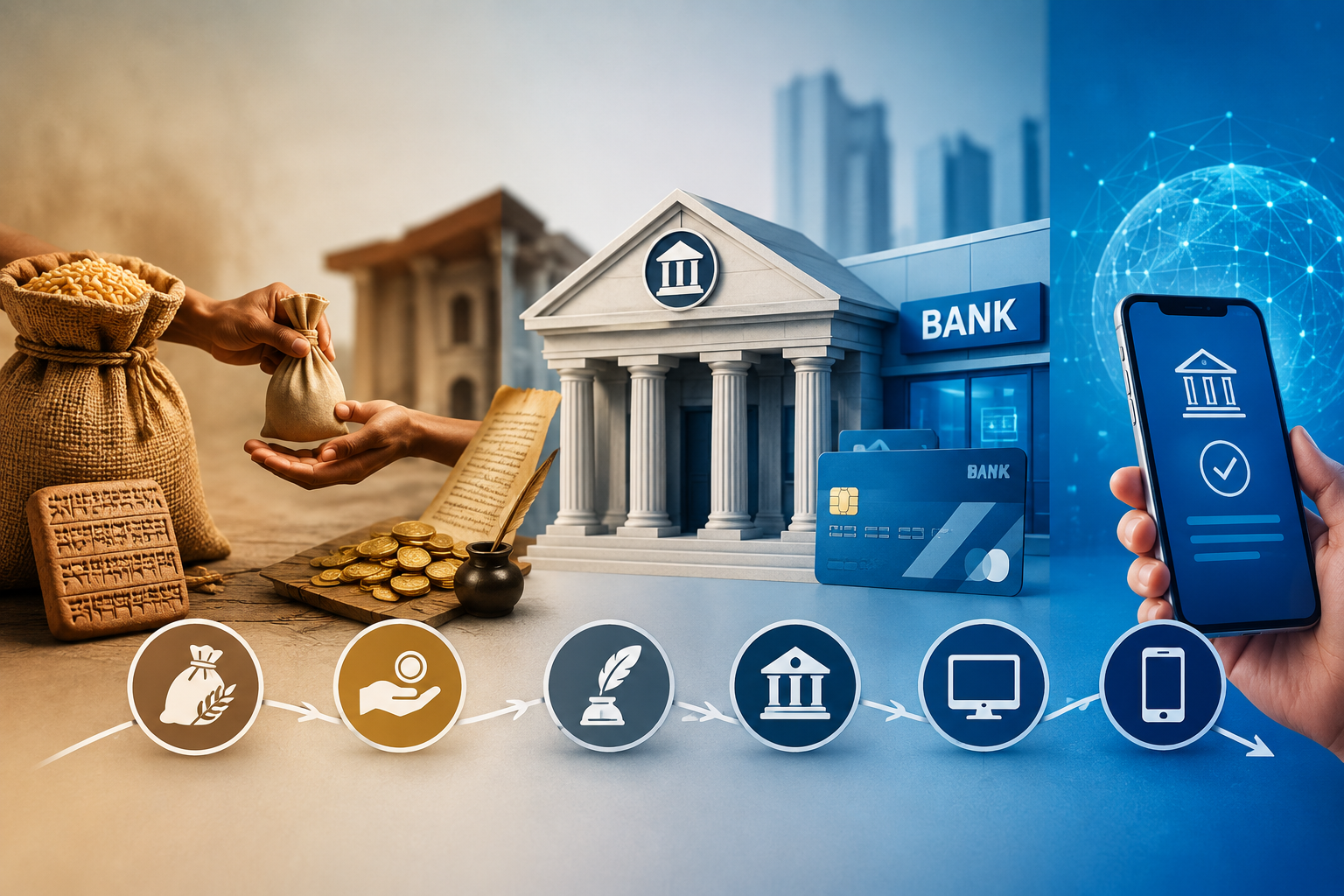
How Did Lending Become Banking? The Evolution of Loans, Credit & Modern Banking
Money and banking are so deeply connected to our everyday lives that it is easy to forget how recently modern banking systems came into existence.
Today, we can apply for a business loan, transfer money, check our credit score or make a payment using a smartphone. But thousands of years ago, there were no banks, ATMs, mobile apps or digital lending platforms.
Yet people still borrowed.
Farmers needed resources before harvest. Traders needed money or goods before completing a transaction. Business owners needed capital to expand. Families sometimes needed financial support during difficult times.
This simple need—to receive resources today and repay them later—was the foundation of lending.
So, how did lending eventually become banking?
Let’s take a journey through the evolution of borrowing, lending and banking.
1. Lending Started Before Modern Money
The concept of lending is much older than modern currency.
In ancient societies, people often borrowed commodities rather than money.
For example, a farmer might need grain to plant crops. A trader might need goods to conduct business. Someone could receive the required resources today and repay them after a certain period.
The basic principle was simple:
Receive something today → use it productively → repay it later.
In many early economies, repayment could involve grain, livestock, precious metals or other valuable goods.
This was the beginning of organized credit.
2. Ancient Trade Created the Need for Credit
As communities grew, trade became more complicated.
A merchant might want to purchase goods from one location and sell them somewhere else. But the merchant might not have enough resources available at that exact moment.
This created a financial gap.
Instead of waiting until the merchant had enough money, another individual or institution could provide resources upfront.
The merchant could then complete the transaction and repay later.
This was an early form of business financing.
The important point is that credit helped people conduct business before they had all the money required upfront.
3. The Rise of Moneylenders
As economies developed, individuals began specializing in lending.
Moneylenders provided funds to people who needed them and expected repayment, usually with an additional charge or interest.
This created an important financial relationship:
Lender → Provides capital
Borrower → Uses capital
Borrower → Repays capital + agreed cost
Moneylending became particularly important for merchants, farmers and business owners.
However, lending was still largely personal and local.
There was no standardized banking system like we know today.
4. From Moneylenders to Early Banking
As trade expanded across cities and countries, simply borrowing from an individual was no longer enough.
Merchants needed safer ways to store money, transfer funds and finance trade.
Financial intermediaries began performing several functions:
- Accepting deposits
- Providing loans
- Facilitating payments
- Financing trade
- Exchanging currencies
- Keeping financial records
This was an important step toward banking.
The lender was no longer simply someone who gave money to another person.
A financial institution could now connect people who had surplus funds with people who needed funds.
That is one of the fundamental functions of modern banking.
5. Why Did Banks Become Necessary?
Imagine an economy where everyone keeps their money at home.
Some people may have more money than they currently need.
At the same time, another person may have a strong business opportunity but not enough capital.
A bank can help connect these two sides.
Conceptually:
Depositors → Bank → Borrowers
The bank accepts deposits and, subject to its lending and regulatory framework, provides financing to eligible borrowers.
This allows money to circulate through the economy.
Businesses can invest.
People can purchase homes.
Entrepreneurs can expand.
Infrastructure can be developed.
Economic activity can increase.
This is one reason banking became such an important part of economic development.
6. The Development of Formal Banking Institutions
Over time, banking became more organized.
Financial institutions developed systems for:
- Maintaining accounts
- Recording transactions
- Evaluating borrowers
- Managing risk
- Charging interest
- Providing different types of loans
- Facilitating domestic and international payments
Governments and regulators also became increasingly involved.
Rules were introduced to protect depositors, maintain financial stability and regulate financial institutions.
Banking gradually moved from an informal activity into a structured financial system.
7. From Personal Trust to Credit Assessment
Early lending often depended heavily on personal relationships and trust.
Modern lending is much more structured.
Before approving a loan, a lender may evaluate factors such as:
- Income or business turnover
- Existing financial obligations
- Repayment capacity
- Credit history
- Business performance
- Banking transactions
- Financial statements
- Nature and purpose of the loan
- Security or collateral, where applicable
The question changed from:
“Do I know and trust this person?”
to:
“Does the available information indicate that this borrower can responsibly repay the financing?”
This evolution helped lending become more scalable.
8. The Birth of Different Types of Loans
As financial systems developed, lending became more specialized.
Different borrowers have different requirements.
For example:
Personal Finance
Individuals may require financing for personal needs such as education, housing or other major expenses.
Home Loans
Long-term financing can help individuals purchase or construct homes.
Vehicle Finance
Financing can help individuals or businesses purchase vehicles.
Business Loans
Businesses may require capital for expansion, working capital, machinery, infrastructure or other legitimate business purposes.
Working Capital Finance
Businesses often need funds to manage the gap between spending money and receiving money from customers.
Secured Loans
Some forms of financing are backed by eligible assets or collateral.
The banking system evolved because financial needs evolved.
9. The Rise of NBFCs
Banking is no longer limited to traditional banks.
Non-Banking Financial Companies, commonly known as NBFCs, also became important participants in India’s financial ecosystem.
NBFCs provide various financial services and financing solutions, subject to applicable laws and regulations.
They have become an important part of the lending ecosystem, particularly for different customer and business segments.
This gave borrowers more options and encouraged the financial sector to develop specialized lending products.
10. Technology Changed Lending Again
For centuries, lending involved physical records, face-to-face interactions and paperwork.
Technology changed that dramatically.
Banking gradually moved from:
Branches → Computers → Internet Banking → Mobile Banking → Digital Financial Services
The same evolution happened in lending.
Earlier:
Customer → Branch → Application → Documents → Verification → Loan Decision
Today, technology can enable many parts of the process to happen digitally.
Customers can discover financial products online, submit information digitally and communicate with financial institutions through digital channels.
However, technology has changed the process—not the fundamental responsibility of borrowing and repayment.
11. Digital Lending: The New Chapter
Digital technology has made financial services faster and more accessible.
Customers can now discover loan products through websites, mobile applications, digital campaigns and other online channels.
Data and technology can assist lenders with:
- Customer onboarding
- Document collection
- Verification
- Credit assessment
- Communication
- Application tracking
- Customer service
But digital does not mean risk-free.
A borrower should still understand:
How much am I borrowing?
Why am I borrowing?
What is the total cost?
What is my repayment obligation?
Can I comfortably repay it?
These questions remain just as important today as they were thousands of years ago.
12. How Lending Supports Business Growth
One of the most important roles of lending is helping businesses manage the difference between opportunity and available capital.
Consider an MSME that receives a large customer order.
The business may need to purchase raw materials before receiving payment from the customer.
The business has an opportunity—but there is a cash-flow gap.
Appropriate financing can potentially help bridge that gap.
The cycle may look like:
Order Received
↓
Working Capital Requirement
↓
Purchase Materials / Inventory
↓
Complete Order
↓
Receive Customer Payment
↓
Repay Financing
The financing itself does not guarantee business success.
The underlying business model, demand, margins, execution and cash flow remain critical.
But suitable financing can help a viable business manage its capital requirements.
13. Why MSMEs Need Access to Finance
MSMEs are an important part of the business ecosystem.
A small business may start with the owner’s savings.
As it grows, however, its financial requirements can change.
The business may need:
- More inventory
- Better equipment
- Additional employees
- New premises
- Technology
- Working capital
- Vehicles
- Expansion into new markets
At some point, internal funds may not be sufficient.
This is where formal financial institutions and lending ecosystems can become important.
The evolution from ancient lending to modern banking is, in many ways, also the evolution of how businesses access capital.
14. But Is Every Loan a Good Loan?
No.
Borrowing should always be approached responsibly.
A loan can be useful when there is a clear purpose and a realistic repayment plan.
But borrowing without understanding the financial obligation can create problems.
Before taking financing, a borrower should consider:
- Why do I need the money?
- How much do I actually need?
- What will the money be used for?
- What will be the total cost?
- What will my repayment obligation be?
- Can my income or business cash flow support repayment?
- What happens if my income or business revenue falls?
- Have I understood the terms and conditions?
A loan is not free money. It is a financial commitment.
15. The Evolution Continues
The story of lending has never really stopped.
It started with simple exchanges of resources.
Then came organized lending.
Then moneylenders.
Then financial institutions.
Then banks.
Then NBFCs.
And now technology-enabled financial services.
The journey can be summarized as:
Barter & Commodity Credit
↓
Informal Lending
↓
Moneylenders & Merchants
↓
Early Financial Institutions
↓
Modern Banks
↓
NBFCs
↓
Digital Financial Services
The technology keeps changing.
The fundamental need remains the same:
People and businesses sometimes need capital today to meet a requirement or pursue an opportunity before they have enough available funds.
16. From Ancient Traders to Today’s Entrepreneurs
Thousands of years ago, a trader may have borrowed resources to purchase goods.
Today, an entrepreneur may seek working capital to fulfil a large order.
The tools are different.
The technology is different.
The regulations are different.
But the underlying financial principle is remarkably similar:
Capital can help bridge the gap between today’s requirement and tomorrow’s expected cash flow.
That is why lending has remained an important part of economic activity for centuries.
Conclusion: From Lending to Banking
Banking did not appear overnight.
It evolved from humanity’s basic need to save, transfer, borrow and manage resources.
What began as simple lending gradually developed into sophisticated financial systems involving banks, NBFCs, credit institutions, technology platforms and digital financial services.
For today’s individual or MSME, understanding this history is useful because it reminds us of one important principle:
Borrowing should have a purpose, and every loan comes with a responsibility to repay.
At Rupeeboss, our role is to help individuals and businesses explore financing options from our lending partners based on their requirements and eligibility.
Need a loan? You’re not alone.
Rupeeboss — Need a loan, you are not alone!
Frequently Asked Questions
1. When did lending first begin?
Lending is thousands of years old and existed before modern banking. Early societies borrowed commodities such as grain and other valuable resources.
2. Who invented the first loan?
There is no single known person who invented the first loan. Lending developed independently as communities began trading, storing resources and managing financial needs.
3. Why did people start borrowing?
People borrowed to manage shortages, conduct trade, finance agriculture, support business activities and meet other financial requirements.
4. How did lending become banking?
As economies and trade expanded, financial intermediaries began accepting deposits, facilitating payments, financing trade and providing loans. These functions gradually developed into formal banking systems.
5. How has technology changed lending?
Technology has made many financial processes faster and more accessible, including digital applications, document submission, verification, communication and application tracking.
6. Do businesses need loans to grow?
Not necessarily. Businesses can grow through internal funds, profits and other sources of capital. However, suitable financing can help businesses manage working capital, expansion and other legitimate financial requirements.
7. Should everyone take a loan?
No. Borrowing should depend on the individual’s or business’s financial situation, purpose, repayment capacity and the terms of the financing.
8. What is the most important thing to remember before taking a loan?
Understand the purpose, amount, total cost and repayment obligation before borrowing. Responsible borrowing starts with understanding your ability to repay.